
Server-Guard · Intelligent Ops Engine
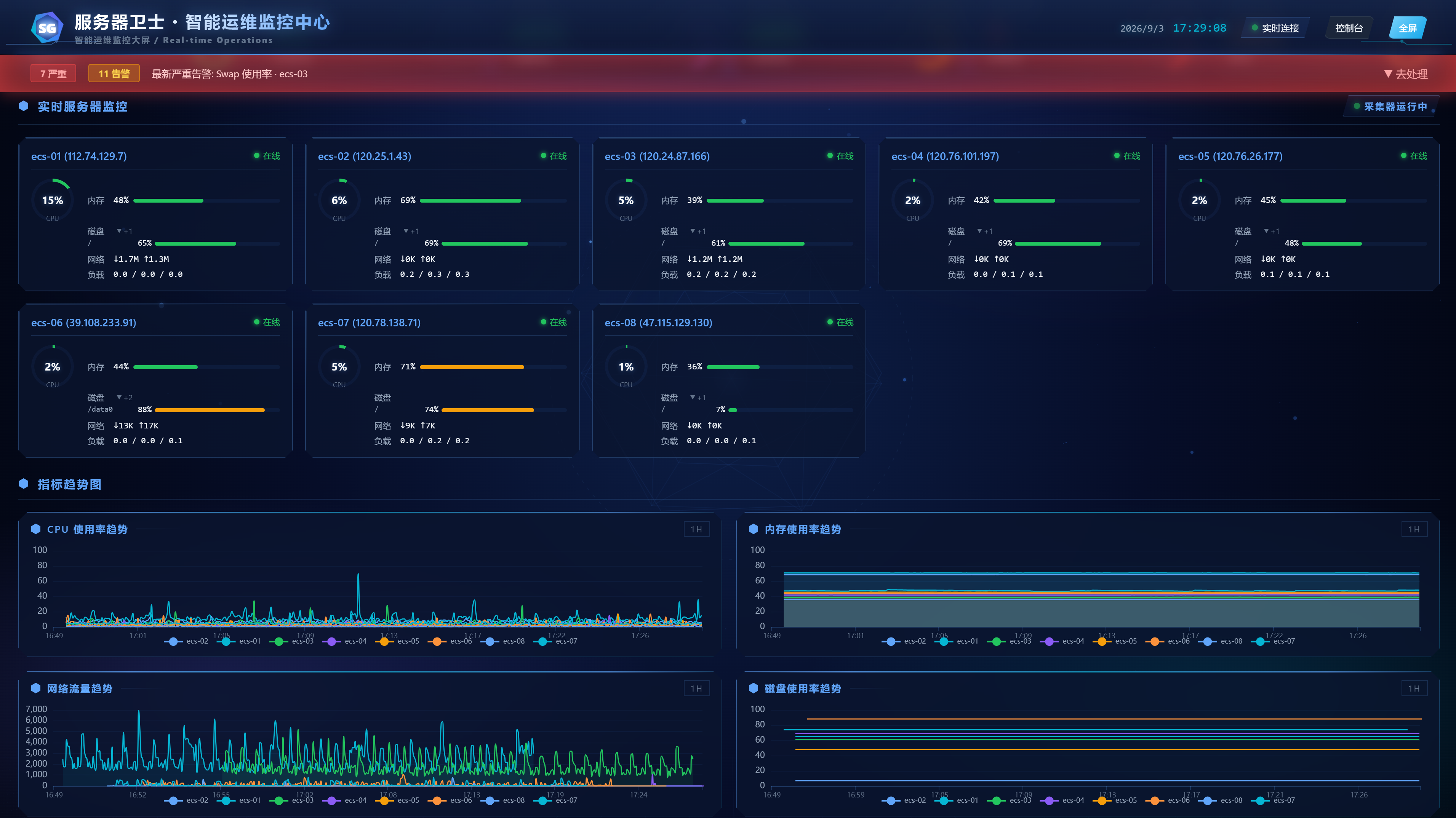
24/7 Guard After Launch
Around-the-clock monitoring and fast response stop risks before users feel them.
Watch Pipeline: From Alert to Closure
- 01
Inspect
31 checks on schedule, collected in parallel — anomalies surface immediately.
- 02
Alert
Prometheus / Zabbix wired in; dedupe-and-enrich staging keeps alert storms out.
- 03
Diagnose
LLM root-cause analysis plus playbook rules — structured, actionable fixes.
- 04
Heal
Low-risk fixes run automatically over SSH — rollback-ready, verified after repair.
- 05
Approve
Humans sign off on high-risk moves via mobile or console — AI never oversteps.
31-Item Automated Inspection Matrix
3131 checks · three categories
System resources
- CPU health (dual sampling)
- System load
- Memory
- Swap
- Disk mount points
- Process / port liveness
- Kernel OOM / panic
- systemd services
Application layer
- JVM heap & GC
- Nginx config & error logs
- Redis slow queries
- Docker containers & image age
- MySQL status
- Java threads
Security audit
- OS lifecycle (EOL early warning)
- Login-capable user inventory
- Zombie processes
Scheduled with distributed locks for parallel collection; parsers adapt — present components get checked, absent ones skipped, no false alarms.
Four-Level Risk Response
- LOW
Low
- Handling
- Auto-approved
- Typical Scenario
- Log cleanup, temp-file cleanup, non-critical service restarts
- MEDIUM
Medium
- Handling
- Human approval (mobile notice)
- Typical Scenario
- Database restarts, config changes with reload
- HIGH
High
- Handling
- Human approval (dual-channel confirm)
- Typical Scenario
- Multi-service impact, data changes, batch operations
- CRITICAL
Critical
- Handling
- Console approval + mandatory rollback plan
- Typical Scenario
- Operations that could interrupt service or lose data
Three-layer risk scoring with time awareness — risk levels auto-escalate during peak hours.
Human-in-the-Loop Approval
Humans make the call on critical actions: a four-state machine keeps everything on record — approve anytime from mobile IM or the web console.
- Created
- Notified
- Pending
- Approved / Rejected
- Auto-reject on timeout
- Crash-recoverable
- Dual-channel notice & approval
Defense-in-Depth Security
Hard command blocking
7 danger classes, 21+ fatal commands permanently blocked — filesystem damage and privilege opens never run.
5-tier roles, deny by default
Scoped from read-only to batch execution with regex whitelists; anything not explicitly allowed is denied.
Full-chain audit trail
Every inspection, alert, diagnosis, approval and execution is persisted — traceable up to 365 days.
AI Diagnostic Core
Dual-LLM diagnosis
Dual providers with automatic failover and circuit breaking; batch diagnosis with independent root-cause analysis.
Playbook rules
Built-in playbooks for disk, CPU, Nginx and more — rule matching and stepped execution alongside the LLM.
Multi-agent orchestration
Five agent roles — inspect, alert, diagnose, execute, batch — scheduled per scenario with decomposition, concurrency and retries.
RAG knowledge retrieval
Semantic retrieval over past cases and ops manuals — every decision informed by history.
Zero external dependencies
- No MySQL / Redis / message queues
- SQLite + JSONL out of the box
- Single-node deployment, minimal ops cost
- One node guards dozens of servers
Certificate Lifecycle Management
01
Tiered expiry warnings
Warnings at 30/14/7 days and on expiry, plus drift and missing-cert detection on a schedule.
02
ACME auto-renewal
A self-built RFC 8555 client renews automatically — private CAs and manual uploads as fallback.
03
Gated deployment
High-risk gates with atomic replacement, three-stage checks and automatic rollback on failure.
04
Private-key safety
0600/0700 permission enforcement (fail-closed), 7 rolling backups, fully audited access.
Real Disposal Scenarios
Disk alert, handled at 3 a.m.
Monitoring pushes a disk-at-95% alert; AI blames log bloat, risk scores low, cleanup runs automatically — disk recovers with zero human touch.
Java OOM, one-tap diagnosis
An inspection catches old-gen at 95%, queues a heap-dump request for approval — tap "approve" on your phone and it runs. No SSH needed.
Bad config, caught in time
AI suggests a reload, but syntax checks fail: the safety layer flags it, blocks execution and pushes approval with a rollback plan — an outage averted.
Certificates, renewed on schedule
Warning 30 days out, ACME renews automatically; after approval, atomic replacement and health checks run — with rollback if anything fails.
Core Capabilities
Around-the-clock monitoring
Unified monitoring across systems, apps and business metrics — anomalies reach the right person immediately.
Fast incident response
Tiered response and playbooks in place — recovery first, retrospective after.
Routine inspection and maintenance
Patches, backups, certificates and capacity checked on schedule — risks removed early.
Security hardening
Baseline checks and security patches kept current to shrink the attack surface.
Capacity and cost tuning
Continuous observation and tuning keep performance steady and costs lean.
Delivery Process
- 1
Assessment
Take stock of assets and risk baselines; define the care scope and priorities.
- 2
Monitoring onboarding
Stand up monitoring and alerting with full visibility of key metrics.
- 3
Playbook setup
Set tiered response and change management, with duties and timings agreed in advance.
- 4
Daily care
Inspections, watch duty and tuning run as a routine; anomalies are handled by the book.
- 5
Review and improvement
Regular health reports feed a rolling loop of retrospectives and improvements.