The Core Impact of Multi-Agent Programming Trends on Future Software Development
Multi-agent programming is rebuilding software development across paradigm, production model, roles, quality, architecture and ecosystem — moving software engineering from the craft-workshop era into AI-industrialized production.
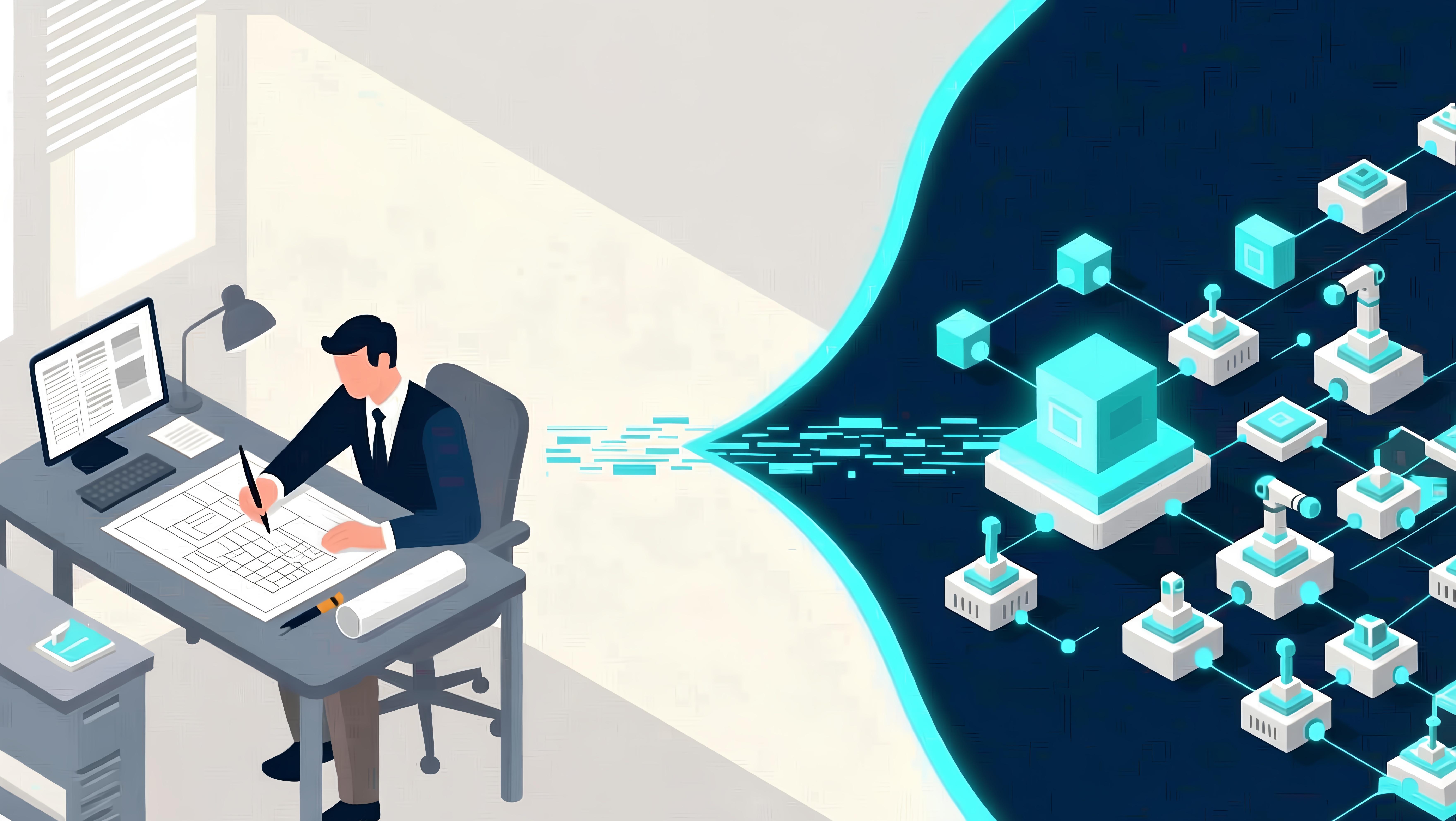
Drawing on the latest multi-agent programming trends of 2025-2026, frontier industry progress and KooDa AI's industrial-scale software factory practice, multi-agent programming is dismantling the traditional hand-crafted, solo-developer engineering paradigm — rebuilding software development across paradigm, production model, roles, quality systems, architecture and ecosystem, and moving software engineering from the craft-workshop era into the era of AI-industrialized software production.
1. Rewriting the development paradigm: from humans writing code to machines industrially producing software
Traditional development hinges on humans writing code, controlling the process and guaranteeing quality — dependent on individual skill, with uneven efficiency, inconsistent standards, unstable delivery and experience that never sediments. Multi-agent programming pairs probabilistic AI execution with deterministic process constraints: humans define goals, business constraints, acceptance criteria and workflows, while agent teams execute requirement analysis, architecture, coding, testing, compliance review and release across the full chain.
Future development is no longer line-by-line coding but the systemic work of process orchestration, rule definition and system governance — lights-out software production that eliminates low efficiency, long cycles and human error.
2. Transforming the production model: from solo serial work to multi-role parallel collaboration
Traditional R&D iterates serially through requirement, development, testing and review — slow and process-heavy. Multi-agent programming mirrors a professional team with dedicated planning, coding, build, test, review, ops and documentation agents, enabling asynchronous parallel development, cross validation and synchronized progress.
With task forking, global state-machine control and an artifact bus, large projects advance subtasks in parallel and compress cycles dramatically. Specialized role division breaks the solo-developer ceiling, giving complex systems scaled, standardized, parallel production capacity fit for large enterprise software and long-lived iterations.
3. Reshaping developer roles: from code craftsmen to AI architects and workflow orchestrators
As repetitive coding, debugging and documentation are fully automated, developers shift from line-level executors to agent managers, workflow designers, quality gatekeepers and architecture decision makers.
Core competence is no longer writing code fluently, but agent role decomposition, workflow-as-code, collaboration rules, acceptance criteria, AI output correction and system-level architecture. Demand for low-end coding labor keeps falling, while hybrid talent fluent in AI engineering, process governance and system design becomes the scarce core resource.
4. Upgrading quality and risk control: from human assurance to full-chain industrial gating
Quality used to rest on manual testing and review, with frequent leaks, bugs and compliance issues. Multi-agent programming builds an industrial quality system on multi-layer gated review, multi-dimensional validation and full-chain traceability — independent reviewer agents run 13 parallel dimensions covering security, performance, architecture standards, business compliance and compatibility, systematically suppressing model hallucination and defects.
A versioned artifact bus keeps requirements, code, reviews, tests and iterations traceable, auditable and replayable — solving uncontrollable quality and untraceable defects, bringing error rates to industrial standards for government, finance and industrial scenarios with high compliance demands.
5. Revaluing engineering assets: from source code to process assets
In traditional development the core asset is source code — experience leaves with people, code is constantly refactored, standards never unify, reuse is poor. In the multi-agent era, source code becomes an ephemeral artifact; workflow rules, collaboration paradigms, business constraints and review standards become the core digital assets.
Enterprises codify, version and reuse mature processes, domain rules and quality standards — defined once, reused across projects — cutting duplicated development cost, while gray-release process iteration and modular upgrades keep the R&D system continuously evolving.
6. Restructuring cost and delivery: from headcount cost to capacity cost
Traditional IT pays per head, with cost growing linearly in project size and iterations. Industrialized multi-agent production rebuilds pricing: pay for delivered capacity and SLA-backed quality, not for people.
Around-the-clock unattended iteration, parallel development and low-rework delivery cut labor, testing and rework costs; the Octopus non-intrusive onboarding strategy lets enterprises adopt AI software production without re-engineering existing systems — cost reduction and quality gains at once.
7. Unifying the ecosystem: breaking model and tool barriers
The industry has formed a standardized ecosystem — LSP code semantics, MCP agent collaboration protocol and multi-model adaptation — free of single-model lock-in, with 75+ large models switchable and tools seamlessly interoperable. Model-generic, tool-interoperable, workflow-reusable architecture slashes selection and adaptation costs, pushing AI software engineering toward standardized scale.
8. Expanding the boundary: from pure digital R&D to digital-physical intelligence
The collaboration closed-loop generalizes beyond software into industrial automation, robot fleet control, intelligent device scheduling and embodied intelligence — the SDLC process and multi-agent system become the production foundation of digital-physical intelligent systems.
Core takeaways
The endgame of multi-agent programming for software development: industrialized paradigm, parallel production, architect-grade talent, controllable quality, sedimentable assets, quantifiable cost, standardized ecosystem and full-spectrum scenarios. Future competitiveness lies not in coding speed or headcount, but in multi-agent orchestration, workflow governance and industrial production capacity — AI software factories like KooDa will be the core infrastructure of next-generation software engineering.
Want to stay in the loop?
Follow our updates, or talk to the team about your project directly.